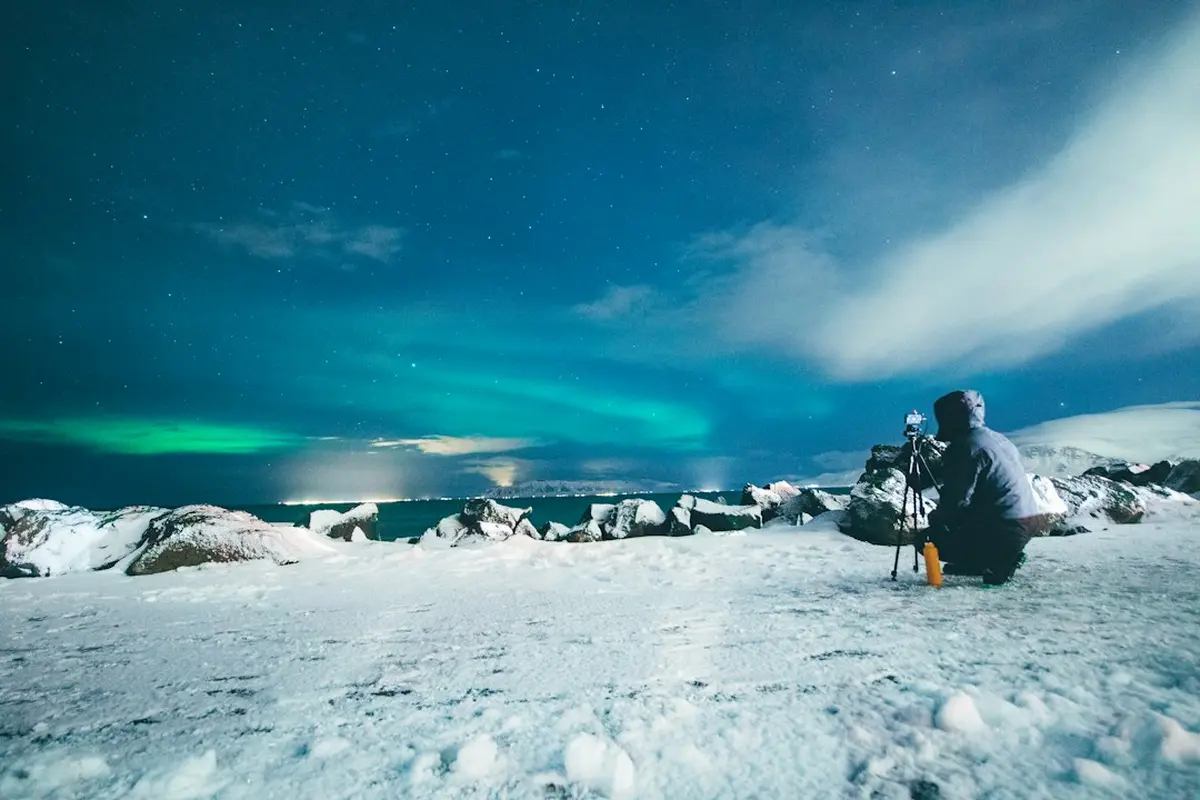
To watch the northern lights, wear three layers on your top half: merino wool against the skin, an insulating fleece or puffy jacket over it, and a windproof, hooded shell on the outside. On your legs, wear merino leggings under insulated trousers. On your feet, wear winter boots rated well below the night's temperature and heavyweight merino socks that don't squeeze your feet. Cover your head, and below 14°F (-10°C) cover your face too. On your hands, wear thin liner gloves inside insulated mittens. Wear no cotton anywhere. This page is for anyone heading to Iceland, Norway, Lapland, Alaska, the Yukon or Greenland who wants to know exactly what goes on, in the order it goes on, for the temperatures they will actually stand in.
Most people get one thing wrong. They dress for the temperature as though they will be moving. Aurora viewing means standing still, often for hours, in the middle of the night. An outfit that is comfortable on a two-hour snowshoe walk at 5°F will leave you shivering at a roadside turnout at the same temperature. Dress one step warmer than the forecast suggests, and make sure you can add a layer rather than having to take one off.
Why a still night needs more than a busy day
Three things set how cold you get: how long you are out, how hard the wind blows, and how much bare skin you leave exposed. Clothing controls the third one fully and softens the other two.
Time. The strongest displays tend to fall between 9 p.m. and 3 a.m., and the best three to four hours center on midnight, according to the Geophysical Institute at the University of Alaska Fairbanks. An Alaska packing guide from Face The Outdoors puts a typical Fairbanks viewing session at 3 to 6 hours of standing outdoors. Aurora Norway's guide gives 1 to 3 hours for Norway. Either way you will be outside far longer than a quick walk from the car, and you will spend most of that time barely moving.
Wind. Wind chill measures how fast bare skin loses heat when wind and cold act together. The National Weather Service gives the working example: at an air temperature of 0°F with a 15 mph wind, the wind chill is -19°F, and at that wind chill exposed skin can freeze within 30 minutes. The NWS also notes that frostbite needs the actual air temperature to be below freezing. A windy 40°F night in Iceland will make you miserable, but it will not give you frostbite. The NWS figure that bright sunshine can offset wind chill by 10 to 18°F does not help you at midnight.
Bare skin. Frostbite most often hits the fingers, toes, ear lobes and the tip of the nose (NWS). Face The Outdoors reports frostbite on exposed skin in under 10 minutes at -25°F and under 5 minutes at -40°F. Those are the parts your outfit has to protect best, and they are also the parts people uncover to work a camera.
The principle behind the whole outfit comes from the NWS: several loose layers that trap insulating air, with a water-repellent, hooded outer layer. Loose matters. A layer that compresses the one beneath it squeezes out the trapped air, and the trapped air is what keeps you warm.
The first layer you pick decides the rest, because once a base layer gets damp from the walk in, it stays damp all night. Three fabrics are worth weighing, and one of them is ruled out.
| Merino wool | Synthetic | Cotton | |
|---|---|---|---|
| Verdict (Aurora Norway, Face The Outdoors) | The default choice for every temperature band | A workable lower-cost option | Do not wear it as any layer |
| Behavior when damp (Aurora Norway; Face The Outdoors) | Recommended by both guides for extended cold | Recommended by Aurora Norway as the budget alternative | "Loses all insulating value" when wet (Aurora Norway); holds moisture against skin (Face The Outdoors) |
| Comfort range (Aurora Norway) | -4°F to 59°F (-20°C to +15°C) | Not given by the source | Not applicable |
| Weight to buy (Face The Outdoors, Alaska) | 200 to 250 weight top and leggings | Not given by the source | Not applicable |
| Brands named (Aurora Norway) | Icebreaker, Smartwool, Devold, Aclima | Odlo, Craft, Falke, Decathlon Forclaz | None |
| Price (Aurora Norway, undated, read September 2026) | €60 to €120 for a set | Described only as cheaper | Not applicable |
| Wrong for | Buyers who need the cheapest set and will only see mild nights | Multi-hour nights well below 0°F, where the Alaska guide specifies merino | Everyone |
Getting dressed, skin out
The steps below follow the order you dress in. Each one tells you what to put on, how to check that it worked, and what it costs where a source gives a price.
This page names products that the sources behind it name and describe. North Wiki did not test any of them. The ratings and prices come from the makers as reported by the guides cited, and they are examples rather than a ranking. The research behind this page has no specifications for the specific mid-layer jackets, insulated trousers, sock models, glove models or headlamps often suggested on packing lists, so those are described by what to look for instead of by model name.
-
Merino wool base layer, top and leggings
200 to 250 weight for Alaska-level cold (Face The Outdoors).
-
Fleece mid layer
Polartec 200 or similar (Aurora Norway); 200 to 300 weight (Face The Outdoors).
-
Down or synthetic puffy jacket
650+ fill power for the coldest nights (Face The Outdoors).
-
Windproof, hooded outer shell or insulated parka
Rated to at least -20°F, ideally -40°F, for interior Alaska (Face The Outdoors).
-
Insulated trousers big enough to go over leggings
They should not compress the layer beneath.
-
Ear-covering hat plus a neck gaiter or balaclava
Aurora Norway adds face cover below -10°C (14°F).
-
Thin liner gloves and insulated mittens
Mittens rated -20°F or colder for Alaska (Face The Outdoors).
-
Heavyweight merino socks, 2 to 3 pairs per night
Face The Outdoors; worn loosely.
-
Winter boots rated to at least -20°C (-4°F), -40°F for interior Alaska
Aurora Norway; Face The Outdoors.
-
Disposable hand warmers, 10 or more for the trip
Face The Outdoors.
-
Spare camera and phone batteries kept inside your jacket
Cold cuts battery capacity sharply (Face The Outdoors).
1. Put on the merino base layer, top and leggings. Choose 200 to 250 weight merino for Alaska-grade cold (Face The Outdoors). Aurora Norway names Icebreaker, Smartwool, Devold and Aclima as merino brands, with Odlo, Craft, Falke and Decathlon Forclaz as cheaper synthetic options. Nordic Visitor's staff call wool base-layer pants and shirts a "must have" for Iceland. How you know it worked: the layer lies flat against your skin without pinching, and your skin is dry, not clammy, after the walk from the car. Cost: €60 to €120 for a quality merino set, per Aurora Norway (undated page, read September 2026).
2. Add the insulating mid layer. On mild nights a fleece or a wool sweater is enough. Nordic Visitor suggests the Icelandic lopapeysa. At -15°C (5°F) and below, Aurora Norway recommends pairing a Polartec 200 fleece with a down or synthetic jacket. For the coldest Fairbanks nights, Face The Outdoors specifies a 200 to 300 weight fleece plus a puffy of 650+ fill power, down or synthetic. How you know it worked: you can raise your arms without the base layer riding up, and the shell still closes over everything without straining. Cost: not given by the sources.
3. Put on the windproof shell or insulated parka. On a mild night, a water-repellent, hooded shell over your warm layers follows NWS guidance. Aurora Norway wants sealed seams and enough room for layering without restricting movement. For interior Alaska, Face The Outdoors calls for an insulated, windproof, breathable parka rated to at least -20°F and ideally -40°F, with Gore-Tex named for weather protection. How you know it worked: with the hood up and zipped, you feel no draft at the neck or wrists when the wind gusts. Cost: not given by the sources.
4. Pull on insulated trousers over the leggings. The sources cover the leg base layer (merino leggings) but do not rate trousers. The practical rule is the same as for the upper body: a windproof outer layer, insulation beneath it, and enough room that the leggings are not squashed. How you know it worked: your thighs are not the first thing to feel cold after 30 minutes of standing. Cost: not given by the sources.
5. Put on socks, heavyweight merino. Face The Outdoors recommends 2 to 3 pairs of heavyweight merino socks per viewing night, worn loosely to preserve circulation. The looseness matters more than the count. A sock combination that makes the boot tight cuts blood flow to your toes, and cold toes follow. How you know it worked: you can wiggle your toes freely once the boot is laced. Cost: not given by the sources.
6. Lace up boots rated well below the forecast. Aurora Norway sets the floor at a rating of -20°C (-4°F) with non-compressible insoles. Face The Outdoors wants -40°F or colder for Fairbanks and names Baffin, Kamik and Sorel. Aurora Norway lists the Sorel Caribou and Sorel Joan of Arctic as rated to -40°C and the Kamik NationPlus as the budget option at €80 to €120. The ratings are the makers' own figures as reported by these guides, and none of the guides says how they were measured. Treat a rating as a ceiling for active use, not a promise for five hours of standing. How you know it worked: after an hour of standing still, your toes still move and you can feel them. Cost: €80 to €120 for the Kamik NationPlus (Aurora Norway, undated, read September 2026); other models are not priced in the sources.
7. Cover your head, then your face. Wear a hat that covers your ears on every night. Below -10°C (14°F), Aurora Norway adds a neck gaiter or balaclava. Face The Outdoors calls full face coverage essential in December and January in Alaska, when the range there runs -30°F to -5°F. Nordic Visitor's rule is that if your head or feet are cold, you will feel it everywhere. How you know it worked: your ear lobes and the tip of your nose, two of the NWS's four frostbite hot spots, are covered and stay warm to the touch. Cost: not given by the sources.
8. Put on liner gloves, then mittens. The NWS says mittens outperform gloves. Both Aurora Norway and Face The Outdoors pair thin liner gloves (merino or synthetic) inside insulated mittens, and Face The Outdoors wants the mittens rated -20°F or colder for Alaska. To use a camera or phone, slip the mitten off and work in the liner, then warm your fingers back up inside the mitten afterward. Nordic Visitor suggests fingerless or separated-finger gloves for the same job. How you know it worked: you can take a set of photos and get feeling back in your fingers within a few minutes of putting the mittens back on. Cost: not given by the sources.
9. Fill your pockets. Bring disposable hand warmers (Face The Outdoors suggests 10 or more for a trip) and spare batteries. Face The Outdoors reports that cold can cut a camera battery from roughly 500 shots to about 100, so keep spares in an inside pocket where your body heat reaches them. Many viewers also carry a headlamp with a red-light mode. None of the sources behind this page covers headlamps, so this page names none. How you know it worked: a spare battery from your inner pocket brings a dead camera back to life. Cost: not given by the sources.
The table below matches the whole outfit to the temperature you will stand in. Where a source gives a figure, the source is named in the cell. The trouser row applies the upper-body layering rule to the legs, because none of the sources rates trousers.
| Mild: about 36 to 47°F (+2 to 8.5°C) | Cold: about 27 to 14°F (-3 to -10°C) | Very cold: about 5 to -20°F (-15 to -29°C) | Extreme: -22 to -40°F and below | |
|---|---|---|---|---|
| Where and when (source) | Reykjavík in September, 8.5°C / 47°F average (Aurora Iceland); early autumn in Norway, around +2°C (Aurora Norway) | Tromsø in January, -3 to -8°C / 27 to 18°F average (Aurora Norway) | Inland northern Norway in January, down to -25°C / -13°F (Aurora Norway); Fairbanks, regularly -20°F (Face The Outdoors) | Svalbard, regularly -30°C / -22°F (Aurora Norway); Fairbanks extremes below -40°F (Face The Outdoors) |
| Base layer | Merino or synthetic top and leggings | Merino top and leggings | 200 to 250 weight merino (Face The Outdoors) | 200 to 250 weight merino (Face The Outdoors) |
| Mid layer | Fleece or wool sweater such as a lopapeysa (Nordic Visitor) | Fleece, with a puffy on hand for wind | Polartec 200 fleece plus down or synthetic jacket (Aurora Norway) | 200 to 300 weight fleece plus 650+ fill puffy (Face The Outdoors) |
| Outer layer | Water-repellent hooded shell (NWS) | Windproof shell, sealed seams, room for layers (Aurora Norway) | Insulated windproof parka rated to at least -20°F (Face The Outdoors) | Parka rated to -40°F, Gore-Tex shell (Face The Outdoors) |
| Legs | Merino leggings under windproof trousers | Merino leggings under insulated trousers | Merino leggings under insulated trousers, sized loose | Merino leggings, extra insulation, insulated trousers |
| Head and face | Hat covering the ears | Hat plus neck gaiter or balaclava below -10°C (Aurora Norway) | Hat plus balaclava, no bare skin | Full face coverage (Face The Outdoors) |
| Hands | Liner gloves, mittens in a pocket | Liner gloves inside insulated mittens (Aurora Norway) | Liners inside mittens rated -20°F or colder (Face The Outdoors) | Liners inside mittens rated -20°F or colder, plus disposable warmers |
| Feet | Waterproof winter boots, merino socks | Boots rated to at least -20°C / -4°F (Aurora Norway) | Boots rated to -40°F (Face The Outdoors), heavyweight merino socks | Boots rated to -40°F or colder, 2 to 3 pairs of heavyweight merino socks per night (Face The Outdoors) |
Matching the table to the month. The Geophysical Institute puts the Fairbanks viewing season at roughly August 21 to April 21, because outside that window the sky never gets dark enough. It also finds that aurora is about twice as likely near the equinoxes as near the solstices, which makes September and March the strongest months. September sits in the mild column in Iceland and coastal Norway. December and January sit in the cold to extreme columns depending on where you are. The sources behind this page give no March temperatures for any destination, so for a March trip, go by the local forecast for your actual nights rather than a seasonal average.
The mistakes that end the night early
Cotton anywhere in the outfit. Jeans, a cotton hoodie or cotton socks soak up the sweat from the walk to the viewpoint and then sit cold against your skin for the rest of the night. Every dressing guide cited here rules out cotton. How to recognize it: the layer feels damp an hour in, even though it isn't raining. What to do: replace it with merino or synthetic before the trip, not on the night.
Boots laced tight over extra socks. Face The Outdoors stresses that the socks are worn loosely to preserve circulation. How to recognize it: your toes go numb while the rest of you is comfortable. What to do: take a pair of socks off and relace. A boot with room in it is warmer than a boot stuffed full.
Mittens off too long for photos. The liner-glove system works only if the mitten goes back on. How to recognize it: the NWS lists numbness and white or pale skin as frostbite signs. What to do: get your hands back into the mittens and warm them there. At -25°F, Face The Outdoors puts frostbite on exposed skin at under 10 minutes.
Dead batteries at the peak of the display. How to recognize it: a camera that showed a full charge in the car shuts down within minutes. What to do: carry spares in an inside pocket and swap them. A battery that has warmed up often recovers some of its charge.
Heated gear that isn't safe. In 2026 the U.S. Consumer Product Safety Commission acted on several heated cold-weather products:
- A recall of about 1.5 million OCOOPA rechargeable hand warmers, announced July 30, 2026, covering models UT3053, UT3056, ZLS-118, ZLS-118S, ZLS-118D, H01 and H01(PD). They were sold September 2018 through May 2026 for $15 to $60. The CPSC records 1,480 overheating reports, 15 fires, 350 burn injuries and one death.
- A warning on Junsyoung heated insoles, issued March 5, 2026, after burns that required skin grafts.
- A recall of about 195,000 JKMAX heated blankets and heating pads, announced September 17, 2026.
Ocoopa's rechargeable warmers, including the UT3 Lite, often appear on aurora packing lists. The research behind this page does not establish whether a unit sold as the UT3 Lite carries one of the recalled model numbers, so this page does not recommend it. Check the model number printed on any Ocoopa warmer against the CPSC list before you pack it. Disposable warmers carry no battery risk. What to do with any battery-heated item: the CPSC's lithium-ion battery guidance says to buy products certified by a recognized testing laboratory, to use only the maker's charger, to treat charging as the riskiest time, and never to charge on a bed or sofa. That last point matters in a hotel room with a pile of gear on the bed.
Missing the signs of hypothermia. The NWS cold-weather FAQ defines hypothermia as a core temperature below 95°F (35°C). The signs are shivering, memory loss, confusion, slurred speech and drowsiness. What to do: get the person indoors and warm the core first, not the hands and feet. Give warm, not hot, drinks, and no alcohol or caffeine. Drowsiness in someone who was chatting an hour earlier means the night is over.
Iceland in September is not Fairbanks in January
Iceland, September. Reykjavík averages about 8.5°C (47°F) in September, according to Aurora Iceland. That figure is a monthly average, not a nighttime low, and the sources don't give a September night low. Average cloud cover is 6.0 eighths, as cloudy as January, so you may spend a long time waiting for a gap in the clouds. At these temperatures frostbite is not the risk, because the NWS says it needs air below freezing. Wind and damp are the risks. Put your money into a good shell and a wool mid layer, and skip the -40°F parka.
Coastal and inland Norway. Tromsø averages -3 to -8°C (27 to 18°F) in January, with wind chill down to -20°C (-4°F), while inland January nights reach -25°C (-13°F), per Aurora Norway. A town on the coast and a valley a short drive inland can sit in different columns of the table on the same night. If you book a tour that heads inland to find clear skies, dress for the inland figure. Readers booking northern Norway this winter can find booking specifics in our piece on Tromsø and Alta operators.
Svalbard and interior Alaska. Svalbard regularly reaches -30°C (-22°F) (Aurora Norway), and Fairbanks regularly drops to -20°F with extremes below -40°F (Face The Outdoors). At this end of the range the whole extreme column applies: full face cover, -40°F boots, a 650+ fill puffy under the parka. The Geophysical Institute's warning applies too: in remote areas, "small problems may become disasters."
Wind turns one column into the next. The NWS example shows that a 15 mph wind makes a 0°F night feel like -19°F on bare skin. When your forecast shows real wind, dress one column colder.
Children and older viewers. The NWS lists children under 2 and adults over 65 as the groups most at risk of hypothermia. Plan shorter sessions for them, with a warm car or cabin nearby.
Heated apparel sold in the United States. No single mandatory U.S. rule covers heated clothing. The CPSC's wearables standards page explains that the agency relies on voluntary UL and ASTM standards and advises looking for a recognized third-party certification mark. That makes the mark on the label your main check. If you are considering a battery jacket for long stationary nights, our look at heated jackets for standing still covers that category.
Costs, and what the outfit buys you
The sources price only the base layer and one boot. They give no prices for shells, parkas, insulated trousers, mittens or socks, so this page cannot give a total cost for the outfit.
What the outfit buys you is more nights outside. Farmers' Almanac puts the odds of seeing aurora on a single night at roughly 50%, rising above 80% when you allow three to four nights. The Geophysical Institute likewise says three nights substantially improves your chances. If your gear keeps you comfortable for an hour, you get one short try each night. If it keeps you comfortable from 9 p.m. to 3 a.m., you cover the whole window when displays are strongest, and you can do it again the next night. When you choose what to spend on, favor the items that end nights early when they fail: boots, mittens and face cover. A tracking app tells you when to be outside, and our comparison of aurora forecast apps covers those. Your clothing decides whether you can stay out when the app says to.
Comments
No comments yet. Be the first to comment!
Leave a Comment