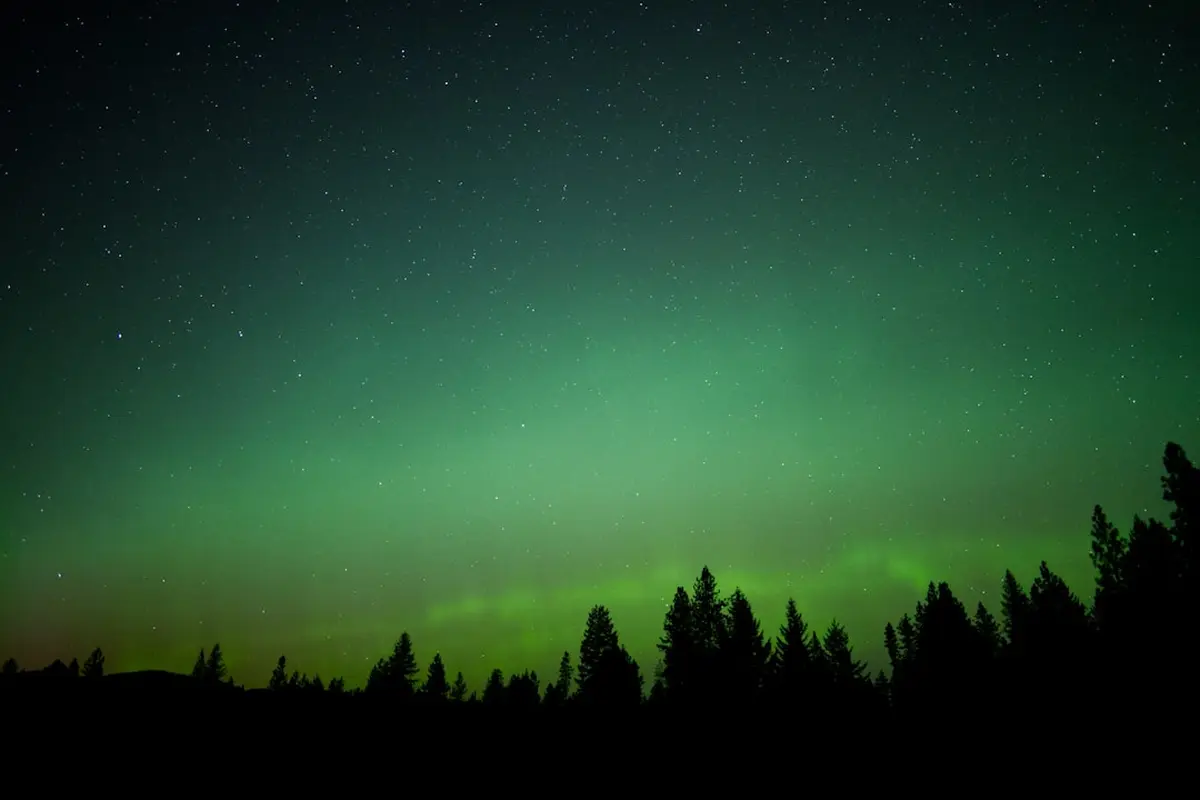
If you can only get outside on a handful of nights this month, take the ones between tonight and September 20. The equinox itself arrives at 00:05 UTC on September 23, and NOAA's 27-day outlook puts the month's second storm window on September 24 to 26, but that window collides with a full moon on the 26th. The nights just before the equinox give you darkness without moonlight; the nights just after give you a better statistical shot at a storm and a sky washed out by the moon.
The reason September gets singled out at all is the Russell-McPherron effect: a geometric alignment that, twice a year, makes it easier for the solar wind to link up with Earth's magnetic field and dump energy into it. It is not a forecast. It is a loading of the dice, and it is worth knowing exactly how much it loads them.
Why the shield opens twice a year
The solar wind carries a magnetic field with it, the interplanetary magnetic field. For aurora, one component of that field does nearly all the work: the north-south one, usually written Bz. When it points south, opposite to the field on the sunward face of Earth's magnetosphere, the two fields connect and solar wind energy gets inside. When it points north, most of the wind slides around the outside and nothing much happens.
Around the equinoxes, the tilt of Earth's magnetic axis relative to the Sun means the incoming field is more often oriented southward as Earth sees it. Same solar wind, better angle. Christopher Russell and Robert McPherron at UCLA set this out in a 1973 paper, Semiannual variation of geomagnetic activity, after the pattern had already been noticed by Aloysius Cortie in 1912 and written up by Chapman and Bartels in 1940, as EarthSky's account of aurora season records.
There is a second, smaller geometric bonus running alongside it. Near the equinoxes, Earth's magnetic poles swing perpendicular to the solar wind flow twice a day, which briefly raises how effectively that wind couples to the magnetosphere. Different mechanism, same season.
What 9.5 percent of September buys you
The effect shows up as a plain frequency count. Geomagnetic activity is logged in three-hour blocks, and storm-level blocks are roughly twice as common at the equinoxes as at the solstices.
Read that honestly: even in the stormiest month, more than nine in ten three-hour blocks are not at storm level. The equinox effect doubles a small number. It does not deliver aurora on demand, and it says nothing about any specific night.
One claim worth flagging because you will see it repeated: the current solar cycle peaked in late 2024, and elevated activity from that maximum is still feeding this season. Whether the cycle is running a second, later peak into 2026 is not something the NOAA material or the sources here establish, so treat that framing as unconfirmed rather than fact.
The next ten nights, date by date
Now to September 20. This is the darkness window. Iceland gets 4.8 to 5.7 hours of astronomical darkness across these nights with no moonrise inside that window at all, and from the 17th to the 19th the moon does not rise over Iceland even though it is 40 to 60 percent illuminated. Moon phases are the same everywhere but rise and set times are not, so check your own latitude. The catch is activity: NOAA's outlook had the active period running September 14 to 16, driven by a negative-polarity coronal hole high-speed stream, with a G1 warning valid to 0600 UTC on the 16th. One consumer forecast had September 19 to 23 mostly quiet, around Kp 2. Dark skies, modest odds.
September 21 to 23. A waxing moon progressively eats the moon-free dark hours. The equinox falls at 00:05 UTC on the 23rd. The alignment peaks here; the forecast activity does not.
September 24 to 26. NOAA's 27-day outlook forecasts G1 minor storming on these three days from a recurrent positive-polarity coronal hole high-speed stream, with active levels continuing into the 27th before things go quiet. Forecast Kp is 5, dropping to 4 on the 27th. "Recurrent" is the useful word: the Sun turns roughly every 27 days, so a stream that hit Earth in mid-September comes back around. The problem is the full moon on September 26. You need a genuinely strong display to beat that much moonlight, so if you are travelling for this, the 24th is the better of the three nights.
Everything else in the outlook window is expected to be largely quiet.
Where this already showed up this month
Two September events make the pattern recognisable. In the first week, active region AR4524 fired at least four Earth-directed coronal mass ejections between the 5th and 6th, including a halo ejection from a C5.0 flare first seen in coronagraph imagery at 1112 UTC on the 6th. NOAA upgraded a G1 watch to G2, which would have pushed visibility as far south as New York, Wisconsin and Washington state. It did not hold: the watch was cancelled at 2101 UTC on September 9 because "conditions no longer warrant watch criteria."
The second was quieter and more typical of equinox season. Twin coronal holes rotated into Earth-facing position in mid-September, sending solar wind at 650 to 800 km/s against a normal background of about 400 km/s. That produced isolated G1 intervals and roughly a 36-hour observing window, no flare required. Coronal hole streams are the workhorse of September aurora, and they are far more predictable than CMEs because the holes come back with the Sun's rotation.
Two things it isn't
The first confusion is with the equinoctial effect, which shares the season but not the mechanism.
| Russell-McPherron | Equinoctial effect | |
|---|---|---|
| What tilts | Earth's magnetic axis relative to the Sun, favouring a southward Bz | Earth's magnetic poles relative to the solar wind flow direction |
| Rhythm | Semiannual, broad peaks around both equinoxes | Twice daily, strongest in the equinox months |
| Effect | More frequent southward field, so more reconnection | Solar wind briefly becomes more geoeffective |
The second is treating the effect as a prediction. It changes the base rate across a month, not the odds on a given evening. The forecast quiet spell across September 19 to 23 sits directly on top of the equinox, which is the cleanest possible demonstration: the geometry was as good as it gets and the solar wind had nothing to give.
What to check before you stand outside
Watch the Kp number, and know what it is measuring. NOAA's planetary K-index is built from 13 ground observatories sitting between 44 and 60 degrees geomagnetic latitude, on a 0 to 9 scale, with 5 the official storm threshold. It is a global three-hour average, not a reading of your sky. At Kp 5 the reliable ground is Alaska, northern Canada, Iceland and Scandinavia, with northern Michigan, Scotland and the Baltics an outside chance under clear skies.
Give yourself less lead time than you think. NOAA's SOLAR-1 monitor at the L1 point, operational since June 2026 in place of DSCOVR, measures the solar wind 15 to 60 minutes before it reaches Earth. That is the real warning: everything further out is a probability. If you want alerts pushed to you rather than checked by you, the aurora forecast apps worth having are the ones that read that feed directly.
Then plan for the wait rather than the event. Coronal hole activity arrives in intervals across a night, not as a single show, which means one to three hours outside and mostly standing still. That is a different clothing problem from hiking, and the case for battery-heated layers is strongest in exactly this scenario.
Comments
No comments yet. Be the first to comment!
Leave a Comment