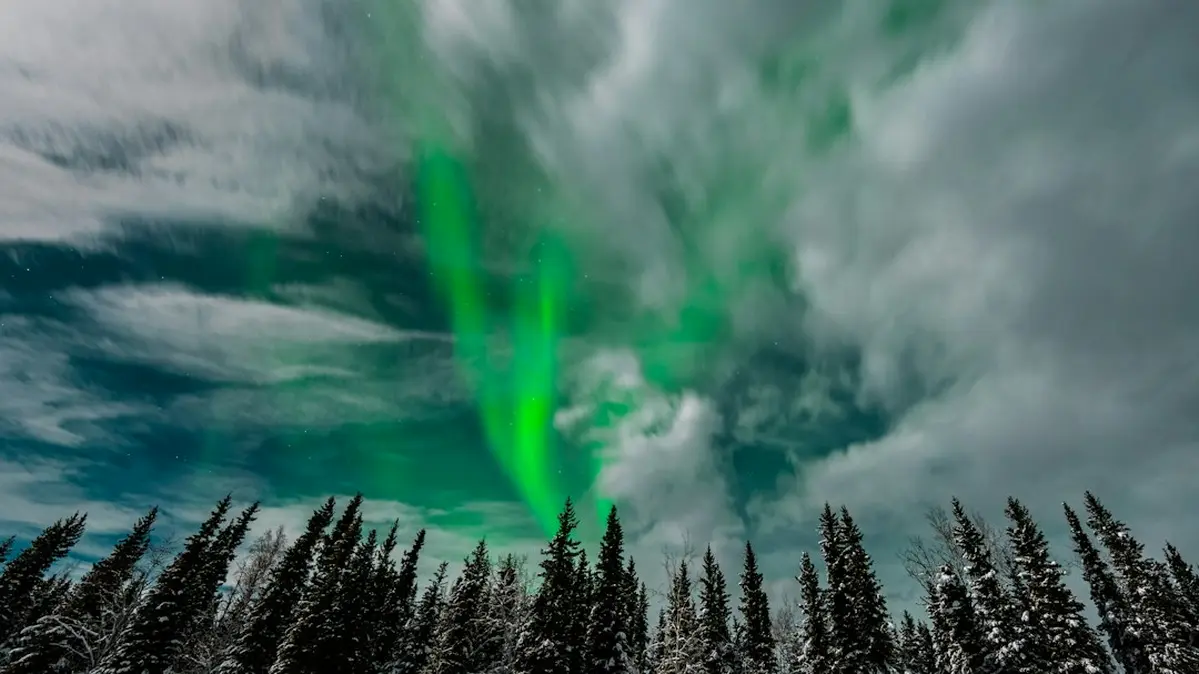
To know whether the aurora will show over Fairbanks tonight, check the University of Alaska Fairbanks Geophysical Institute's 3-day forecast after its daily noon UTC update. Then confirm the sky will be clear, drive a few miles out of town, and watch the northern sky between 10 p.m. and 2 a.m. This page is for anyone planning or already on a Fairbanks trip who wants to know which forecast to trust, what the numbers mean at this latitude, when in the year it works, and where locals go to watch.
The mistake most visitors make is waiting for a big Kp number. Fairbanks sits under the auroral oval, and Explore Fairbanks reports that the aurora is visible on an average of 4 out of 5 nights when skies are clear and dark. On most nights the forecast that decides your evening is the cloud forecast, not the aurora one. The Kp number mostly tells you how bright the display will be and how high it will sit in the sky.
How the Fairbanks forecast works
Every aurora forecast you will see for Fairbanks rests on the same number, the planetary K-index (Kp). According to NOAA's Space Weather Prediction Center, Kp measures disturbances in the horizontal component of Earth's magnetic field on a scale of 0 to 9. Each value is the largest fluctuation recorded over a 3-hour window.
The scale thresholds you need are these, as SWPC defines them:
- Kp 0 to 1: calm to very weak activity.
- Kp 5: a G1 (Minor) geomagnetic storm, the point where "storm" starts.
- Kp 6: G2 (Moderate). Kp 7: G3 (Strong). Kp 8: G4 (Severe). Kp 9: G5 (Extreme).
The Geophysical Institute notes that Kp 9 happens only 1 to 2 times per 11-year solar cycle. Do not plan a trip around one.
What Kp means at Fairbanks' latitude
Fairbanks sits at about 65.6° geomagnetic latitude. The Orbital Radar Fairbanks page says the auroral oval typically reaches the city around Kp 4 and above. Below that, aurora is usually still visible, but it tends to sit low on the northern horizon. As Kp rises, displays get brighter and climb higher toward overhead.
You will find claims online that Kp 2 is enough for structured overhead displays in Fairbanks. None of the sources used for this page support that figure. The safer reading:
- At Kp 2 to 3, look north and expect a horizon display on a clear night.
- At Kp 4 and above, expect aurora that can move up and across the sky.
For how these thresholds compare with Anchorage and the rest of the state, see the statewide Kp thresholds for Alaska.
Why a global number can mislead you locally
Kp is an average from stations spread across the planet, and none of them is in Fairbanks. The sources disagree on the count:
- The Geophysical Institute describes eight global monitoring stations.
- SWPC's product page lists 13 observatories between 44 and 60 degrees geomagnetic latitude, including Sitka, Alaska, and Meanook, Canada.
Either way, Fairbanks is north of the band being measured. The Geophysical Institute forecast tool says so directly: "local conditions could be quite different from global activity." Treat Kp as a guide to the likely strength of the night. Treat a camera or your own eyes as the final word.
The three tools, and which one to use
Three forecasts are worth knowing in Fairbanks. They are not competitors: each answers a different question at a different range. For planning a night, use the Geophysical Institute. For the last hour before you go outside, use NOAA's short-range model. If you want the aurora forecast and the cloud forecast in one place, use Explore Fairbanks' Aurora Tracker.
| Feature | UAF Geophysical Institute forecast | NOAA SWPC OVATION / Aurora Dashboard | Explore Fairbanks Aurora Tracker |
|---|---|---|---|
| What it answers | Which nights in the next 3 days, and roughly which weeks in the next 27, are likely to be active | Where the aurora is and how strong it is in the next 30 to 90 minutes | Whether aurora activity, weather and darkness line up over the next 3 days |
| Lead time (GI; NOAA SWPC; Explore Fairbanks) | 3 days in 3-hour intervals; 27-day outlook | 30 to 90 minutes, plus tonight and tomorrow night viewline forecasts | 3-day outlook |
| How often it updates (GI; NOAA SWPC) | 3-day: daily at noon UTC. 27-day: weekly on Mondays | 30-minute forecast animation; Kp chart refreshes every minute | Not stated in the sources used here |
| What it is built on (GI; NOAA SWPC; Explore Fairbanks) | Kp forecasts; the 27-day outlook relies on solar rotation recurrence | Solar wind and magnetic field data measured at L1, 1.6 million km (1 million miles) upstream of Earth | Geophysical Institute Kp data, local weather forecasts and darkness-duration data |
| Reliability (GI; NOAA SWPC) | 3-day is the most reliable product; 27-day is less reliable | Loses its lead time when solar wind data is missing or contaminated and falls back to current Kp | Depends on its inputs, including the weather forecast |
| Who it is wrong for | Anyone deciding in the moment whether to step outside | Anyone booking lodging or tours days ahead | Anyone who wants the raw science rather than a combined outlook |
If you want a phone app that wraps some of this data, apps are compared separately in our aurora forecast app review. The tools above are the sources those apps draw from.
Checking the forecast on a Fairbanks night, step by step
This is the routine for a single viewing night, from planning in the afternoon to the moment you step out of the car. Before you start, have the following in place.
-
A trip dated between August 21 and April 21
Outside this window Fairbanks nights are not dark enough. This is the official season per Explore Fairbanks and Travel Alaska.
-
The Geophysical Institute forecast bookmarked
gi.alaska.edu/monitors/aurora-forecast, for the 3-day and 27-day outlooks and the live cameras.
-
NOAA's aurora dashboard or 30-minute forecast bookmarked
For the last-hour check before you go outside.
-
A vehicle, or a booked tour or lodge outside town
Travel Alaska advises getting several miles outside downtown to escape light pollution.
-
A chosen spot with an open view to the north
At lower Kp, the display sits on the northern horizon.
-
Clothing for one to three hours of standing still
You will be waiting, not moving, and often well past midnight.
1. Check the 27-day outlook when you plan the trip. Look at the Geophysical Institute's 27-day forecast for weeks that show higher Kp values. It updates on Mondays and is based on the sun's rotation, so treat it as a rough guide to which week looks promising, not which night. It worked if: you have a rough sense of whether your dates fall in a quieter or busier stretch. Cost: a few minutes.
2. Book at least three nights, and four or five if you can. According to Explore Fairbanks and Travel Alaska, visitors who stay a minimum of three nights and stay active late in the evening have over a 90% chance of seeing the aurora. Travel Alaska recommends 4 to 5 nights for a stronger chance. Extra nights protect you against cloud, which no aurora forecast can fix. It worked if: your plan survives one or two cloudy nights. Cost: the extra lodging nights.
3. Read the 3-day forecast each afternoon. The Geophysical Institute updates it daily at noon UTC in 3-hour intervals, so by the Alaska afternoon you are looking at that day's update. Find the 3-hour blocks that cover roughly 10 p.m. to 2 a.m. local time. It worked if: you know whether tonight is forecast at Kp 2 to 3 (look north, expect a horizon display) or Kp 4 and above (expect it to climb higher). Cost: five minutes.
4. Check the cloud forecast, and give it more weight than Kp. Clear skies are the condition every source agrees on. Explore Fairbanks' Aurora Tracker puts the Geophysical Institute's Kp data next to the local weather and darkness hours in one 3-day view. It worked if: you have a clear-sky window that overlaps the late-evening hours. Cost: five minutes.
5. Look at a live camera before you leave. The Geophysical Institute streams live aurora cameras. The forecast page lists Poker Flat Research Range, Toolik Field Station, Gakona and Fairbanks. The Allsky camera site shows Poker Flat, Toolik Lake and Gakona, each with current local weather. Poker Flat is the one to watch for conditions near Fairbanks. It worked if: you can see whether aurora is already showing and whether cloud is sitting over the region. Cost: a minute.
6. Check NOAA's 30-minute forecast as you head out. NOAA's OVATION model gives "a 30 to 90 minute forecast of the location and intensity of the aurora." That lead time is how long solar wind takes to travel from the L1 monitoring point to Earth. It worked if: the oval on the map sits over or near interior Alaska. Cost: a minute.
7. Be outside from about 10 p.m., looking north. Orbital Radar puts peak activity around local magnetic midnight, roughly 10 p.m. to 2 a.m. Travel Alaska gives 10 p.m. to 3 a.m. and advises being ready for late nights or all-nighters. Look north unless activity is unusually strong. It worked if: you see a pale green arc or band on the northern horizon. Explore Fairbanks describes the usual colors as greens, teals and whites, with purple or magenta edges in intense displays. Cost: three to five hours of your night.
8. Stay after the first display fades. Travel Alaska warns that weather and aurora activity can change quickly and reveal displays with little notice. A quiet half hour does not mean the night is over. It worked if: you caught the second or third surge, which is often when displays form curtains, rays or a corona overhead. Cost: sleep.
Where to watch
The spots below are the ones the sources used for this page describe in detail. Explore Fairbanks publishes an official Aurora Viewing Map & Guide with other regional vantage points. Use it for anywhere not covered here; this page does not repeat details the sources did not give.
- Murphy Dome. At 2,877 ft (877 m), this is the highest point near Fairbanks. According to Explore Fairbanks' local viewing guide, it gives an unobstructed, panoramic view away from city light. A two-wheel-drive vehicle is considered acceptable in the first and last months of the season, which includes September. Go here if you want the widest sky. It is the wrong choice in deep winter without a vehicle suited to snow and ice.
- Chena Lake Recreation Area, North Pole. Popular for mirror-image aurora photos on the lake. It works best before the lake freezes and before heavy snow, which makes autumn its window. Go here if you are photographing in September or October. Once the lake freezes, the reflection it is known for is gone.
- Heated aurora cabins, yurts, domes and lodges. Explore Fairbanks lists these among its recommended options, along with dog sled tours, snow cat tours, ice fishing and trips up the Dalton Highway. They suit anyone who does not want to drive at 1 a.m. or stand in the cold between surges. They are wrong for anyone who wants to move spots when cloud rolls in.
Where it goes wrong
Watching in town. Travel Alaska advises getting several miles outside downtown for more vivid displays. How you'll know: the sky looks gray-green and washed out, or you see nothing on a night the camera at Poker Flat shows activity. What to do: drive out to a dark spot with an open northern horizon before you decide the night is a bust.
Trusting a sudden alert to arrive in time. Orbital Radar notes that sudden bursts of solar wind, such as high-speed streams from coronal holes, may give only 15 to 60 minutes of warning. How you'll know: the 3-day forecast said quiet, and an alert fires near midnight. What to do: on a clear night in season, be out anyway. If you are 45 minutes from your spot, you may reach it just as the display ends.
Relying on the 30-minute forecast when its input has failed. When solar wind data from L1 is missing or contaminated, NOAA's model falls back to the current Kp index. Its lead time then disappears. SWPC's live Kp panel was also showing "no data" when checked on September 9, 2026. How you'll know: the dashboard's "Updated Time" is stale, or a panel shows no current reading. What to do: switch to the live cameras and to looking up.
Reading the 27-day outlook as a promise. The Geophysical Institute itself labels it less reliable than the 3-day forecast. How you'll know: a night marked active in a three-week-old outlook comes in quiet. What to do: use the 27-day outlook to pick a week. Use the 3-day forecast to pick a night.
Treating Kp as a Fairbanks reading. Kp is a global average from stations south of Fairbanks, and the Geophysical Institute warns that local conditions can differ. How you'll know: the number and the sky disagree, in either direction. What to do: believe the sky.
Watching on a bright moon. Orbital Radar notes that less moonlight improves visibility of fainter displays. How you'll know: the landscape is bright enough to walk without a headlamp, and faint horizon arcs are hard to separate from the sky. What to do: on low-Kp nights near full moon, wait for the moon to set, or save the effort for a higher-Kp night.
Seasons and nights that change the answer
The season dates. Explore Fairbanks and Travel Alaska both give the official aurora season as August 21 to April 21. Explore Fairbanks calls that about eight months; Travel Alaska says roughly nine. The dates are the part to rely on. Outside them, the sky over Fairbanks does not get dark enough, whatever the Kp says.
September and October. Explore Fairbanks singles out these months for mild temperatures and for aurora reflections on open water, which you lose once lakes freeze. This is also when two-wheel drive is considered fine for Murphy Dome. Travel Alaska adds that late August and early September combine the tail of summer activities with early aurora chasing. This window also sits around the September equinox, which is statistically one of the most active times of the year for geomagnetic activity. That is covered in our piece on the equinox aurora window.
Deep winter. Travel Alaska describes winter as having the longest, darkest nights, plus dog mushing and ice-carving events. Longer darkness means more hours in which a display can happen. The trade-offs are cold, a frozen Chena Lake with no reflections, and roads to high points that may need four-wheel drive. You will also stand still for a long time in serious cold; we looked at heated jackets for standing still separately.
Spring. Travel Alaska describes spring as winter landscapes with milder temperatures. It is a reasonable choice if you want snow in your photos and less cold on your hands.
Storm nights (Kp 5 and above). On a G1 night, the main change in Fairbanks is brightness and height, not whether you see anything. A third-party outlook from Pogodnik notes that Kp 5 improves chances most at high geomagnetic latitudes like Alaska, rather than producing widespread sightings farther south. NOAA says bright aurora can be seen from as much as 1,000 km away in the right conditions. On a strong night, a display centered well north of you can still be in view.
This week in 2026. At the time of research, the Geophysical Institute's forecast showed a projected peak around September 24 to 25 at Kp 5, and around October 5 to 6 at Kp 4. Activity was generally Kp 2 to 3 for the rest of the outlook. Pogodnik, drawing on NOAA SWPC data, flagged a chance of G1 storming around September 23 to 24 and named September 25 to 26 as the best near-term window. It attributed the uptick partly to coronal hole high-speed streams. These were forecasts made in September 2026, not observations; check the current 3-day forecast before acting on them. The sources used here do not quantify how far the recent solar maximum is still raising activity this season, so this page makes no claim about it.
The odds, in numbers
The real cost of a Fairbanks aurora trip is nights: the number you book and the hours you stay up. The figures below are the ones the tourism bodies publish to set expectations, as listed on their pages when this was researched in September 2026. None of the sources used here publish tour or lodging prices, so this page does not quote any.
Explore Fairbanks also reports that year-round residents see the lights on roughly 8 of every 10 nights. That figure is anecdotal, and it comes from people who can step outside at 2 a.m. without planning a drive. As a visitor, plan around the 3-night figure rather than the resident one. When you have seen them, the Morris Thompson Cultural and Visitors Center issues an official Aurora Certificate.
Comments
No comments yet. Be the first to comment!
Leave a Comment