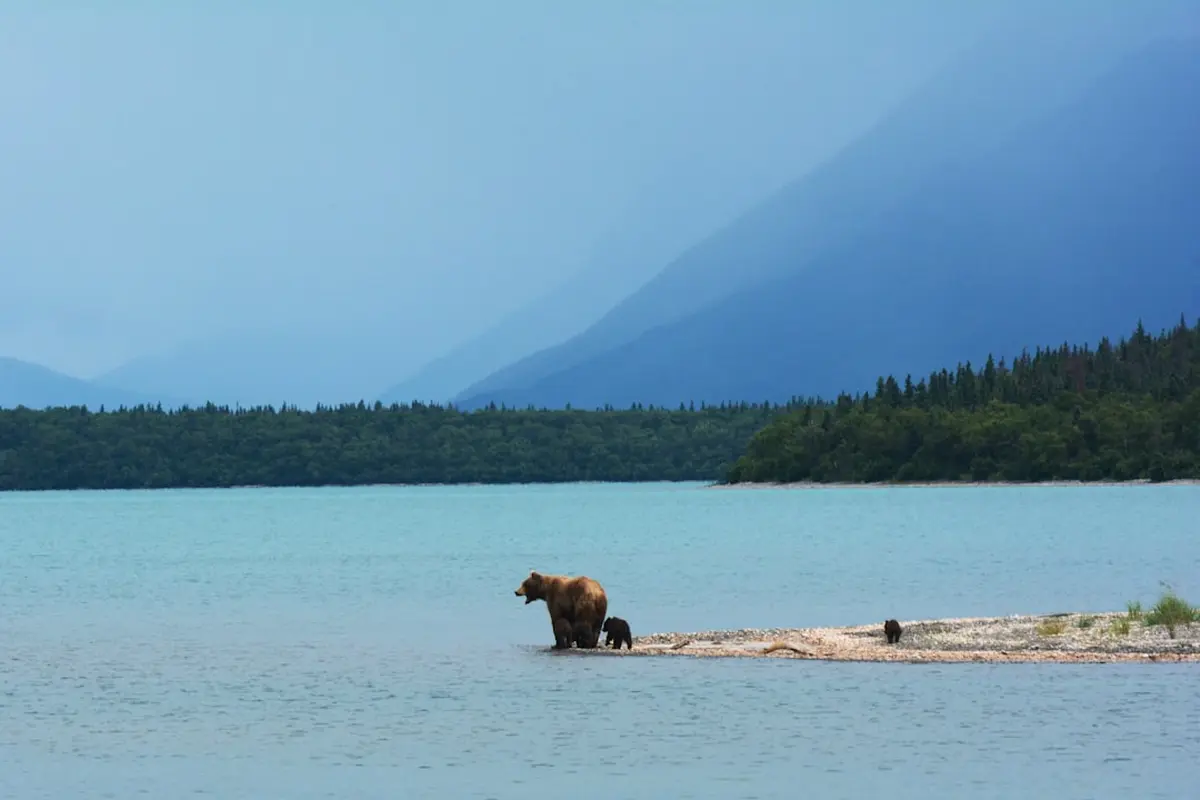
If you are heading into brown bear country this month, the most useful decision you will make is not which deterrent to buy. It is whether you go with someone else.
Jadon Nicoara, a 27-year-old from Walla Walla, Washington, was mauled by a brown bear roughly 100 miles south of Deadhorse, Alaska, in late August 2026, four days into a caribou hunt along the Colville River in Game Management Unit 26B. Three things account for him being alive: his cousin Daniel was standing there with a handgun and used it, Nicoara's own revolver was still reachable after he had been knocked down the hill and bitten in the face, and the pair carried a satellite device that reached the Alaska Rescue Coordination Center from ground with no cell service. Nothing about that sequence required speed, skill or a perfect draw. It required a second person and a working beacon.
If you hunt or hike solo above 60 north, the rest of this applies to you, but understand what you are accepting. Every part of the Nicoara rescue that worked depended on two people being present.
The sequence, in the order it happened
The two men had spotted caribou and were climbing a steep hillside near a canyon when bushes moved above them. The bear came out at 15 to 20 feet, mouth open, growling, at full speed. There was no warning phase, no bluff charge, no distance to close.
It threw Nicoara backward down the hill and bit and scratched him repeatedly, working over his face, hands and feet. Daniel fired at the bear to pull it off. It worked, in the sense that the bear left Nicoara and went for Daniel's legs. At that point Nicoara, on the ground with a shattered nose, drew his revolver and fired, and the bear ran.
Then the part nobody plans for. The two men walked about half a mile to get a satellite SOS out. A helicopter arrived roughly two hours after they reached the extraction point. Nicoara was flown to Deadhorse, then Anchorage, then more than 1,800 miles to Harborview Medical Center in Seattle, the only Level 1 trauma centre serving the Washington, Wyoming, Alaska, Montana and Idaho region. He kept his eyesight and all four limbs. He did not keep his nose, his eye socket or his foot intact, and faced facial reconstruction surgery and more operations after that. Daniel was treated in Anchorage for arm, leg and backside wounds and was expected to recover fully.
I could hear all the bones crunching in my nose. I saw stars, and I was like, 'OK, this is kind of where it ends.'
Defensive or predatory: the call that decides everything
Bear advice sounds contradictory because two opposite responses are correct in two different situations, and you have to tell them apart in about a second.
A defensive bear is reacting to you. It was surprised at close range, or it has cubs, or you are near a carcass. It wants you gone, not eaten. The Alaska Department of Fish and Game says the goal here is to calm the bear and yourself and signal you are not a threat. If a defensive bear knocks you down, lie face down, spread your legs for stability, clasp your hands behind your neck and protect neck, stomach and face.
A non-defensive or predatory bear is not reacting to anything. It is calm, focused on you, and closing. ADF&G is blunt about this one: "Do not play dead! If you panic, run or play dead with a non-defensive bear, you risk the encounter turning into a predatory attack." Here you get loud, get big, get aggressive and use everything you have.
The useful analogy is a dog that barks when you step on its tail versus a dog that stalks silently across a yard. The first wants distance. The second wants you.
The Nicoara bear behaved like a defensive animal surprised at very close range in brush. It also kept coming through gunfire and switched targets, which is why both men ended up shooting. Neither the news coverage nor ADF&G has published a determination of why that bear charged, and the department's aerial search afterwards did not find it.
The protocol to rehearse before you walk in
-
Make noise constantly, and walk with the wind at your back where you can
ADF&G's core prevention advice. Bears that smell or hear you coming leave. Bears that meet you at 15 feet in willow brush do not have that option.
-
If the bear has not seen you, back out the way you came in
Quietly, deterrent in hand, eyes on the animal. Do not loop around it.
-
If it has seen you, stand your ground, face it, talk calmly, raise your arms slowly
Never run. ADF&G puts it in four words: you can't outrun a bear.
-
Deploy bear spray inside 15 to 30 feet, and never upwind
That is the range ADF&G gives for the mist to work. Outside it you are wasting the canister.
-
If a defensive bear makes contact, face down, hands behind the neck
Not at a kill site, and not if you are between a sow and cubs. In those two cases back away and leave.
-
If the bear is calm, silent and following you, fight
Playing dead is the wrong answer to a predatory bear and can make the outcome worse.
-
Carry a satellite messenger and know where a helicopter can land
The Nicoara party walked half a mile to get an SOS out and then waited about two hours. Plan for that gap, not for an ambulance.
What to carry, and what the evidence does and does not show
Carry both a firearm and bear spray. ADF&G specifically recommends that hunters, who already have a rifle or bow, add a second deterrent kept accessible, because the gun in your hands is often slung, loaded for caribou, or pointed the wrong way when a bear comes out of the brush.
On spray's record, the clearest official statement this year came after a separate incident: two soldiers injured by a bear during a land navigation exercise at Joint Base Elmendorf-Richardson in April 2026 were both carrying spray, and ADF&G regional supervisor Cyndi Wardlow said in the department's release that having it with them "may have saved their lives."
Be clear about the limit here: none of the published reporting on the Nicoara attack says whether either hunter carried bear spray, or whether there was any moment when it could have been used. What the reporting establishes is that two handguns, fired at different points by two different people, ended the mauling.
If you are packing meat out, the rest of ADF&G's hunter guidance matters as much as your sidearm. Field dress promptly, pack the meat rather than dragging it so you leave no blood trail, cache it at least 100 yards from the kill site, flag the entrails and the cache, make noise on the return trip, and approach a flagged site expecting a bear to be on it. Killing a bear to retrieve hunter-killed game is illegal in Alaska.
Three things people get wrong
"Play dead" is the rule. It is one branch of two, and using it on a predatory bear is the error ADF&G warns about most directly. Daniel was told to play dead and still took bites to his legs, arm and backside, which is what the posture is for: surviving contact, not preventing it.
A charge gives you time to react. This one came from 15 to 20 feet. The distance that matters is not how far away the bear starts but how much brush is between you.
Bear country is a coin flip. It is not. Alaska averages roughly 3.8 bear-related hospitalisations a year and a fatal attack about once every two years, though the state accounts for something near 29 percent of fatal bear attacks in the United States. State officials described attacks like this one as extremely rare and survival of them rarer still. Prepare as if it will not happen, because it probably will not, and carry the beacon anyway.
If you are going out this month
Go in pairs, with both people armed and both people trained to shoot without hitting each other. Carry spray as your first-reach deterrent and keep it on your chest or hip, not in the pack. Carry a satellite messenger and assume a two-hour minimum from SOS to rotors. Rehearse the defensive-versus-predatory call out loud with your partner before you leave camp, because the decision arrives faster than the reasoning does.
One detail from the coverage is worth keeping. Reports date the attack variously to late August and to the first days of September 2026, and the bear was never located. You will not always get a clean account of what happened to you either. What you can control is who is standing next to you and whether your beacon has a clear view of the sky.
Comments
No comments yet. Be the first to comment!
Leave a Comment