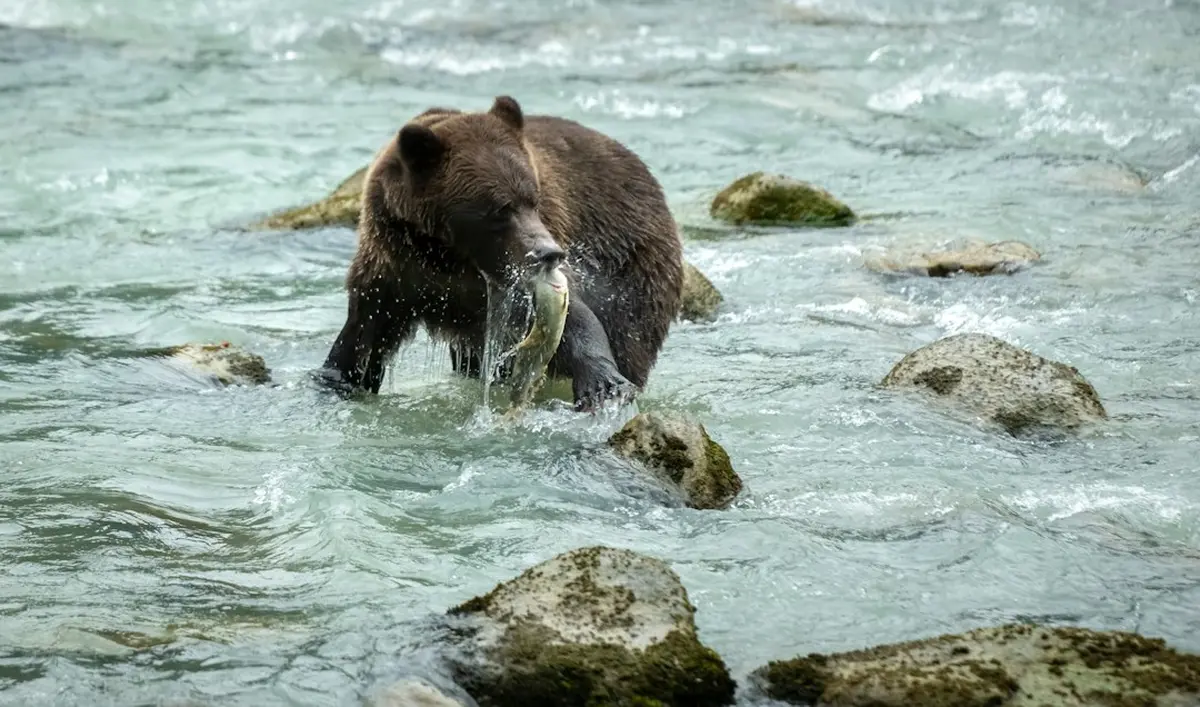
The bracket goes up on Friday, September 18. Voting opens Tuesday, September 22 at fatbearweek.org and closes on September 29, when the 13th champion is crowned. Each day's matchups are open from noon to 9 p.m. Eastern (9 a.m. to 6 p.m. Pacific, 8 a.m. to 5 p.m. Alaska), and there is no voting on the weekend of September 26 and 27. One vote per email address per matchup. That is the whole mechanic.
If you want to watch the bears rather than just vote on them, the Brooks River cams are free on Explore.org and run from late June through mid-October, with separate angles on the falls, the lower river and the riffles. The bears you will be voting on are the ones on those feeds right now, fishing at the top of a salmon run.
Voting, step by step
-
Friday, September 18: check the bracket
Katmai reveals the matchups. A printable version is posted on Explore.org if you want to make predictions.
-
Tuesday, September 22: first polls open at noon Eastern
Single elimination. The bear with more votes in a matchup advances.
-
Compare the two photos, not your favourite
Each bear is shown in an early-summer and a late-summer image. The question is which one better shows a summer of successful fishing.
-
Skip the weekend
No matchups run September 26 or 27. Voting resumes for the finals week.
-
Tuesday, September 29: champion announced
The Katmai Conservancy then holds an online celebration fundraiser on October 3.
The bears worth knowing before Friday
Nobody outside the park knows the 2026 field yet, and anyone telling you the matchups today is guessing. What is confirmed is who is expected back.
Bear 32, Chunk, is the defending champion. He took 2025 with 96,350 votes at an estimated 1,200-plus pounds, and he did it with a freshly broken jaw, most likely from mating-season fighting. Popular Science describes him by his narrow-set eyes, dark fur, heavy brow ridge and facial scar, which is the fastest way to pick him out on the falls cam.
Bear 128, Grazer, won back to back in 2023 and 2024 and is one of only three female champions in the event's history. Her yearling won Fat Bear Junior in 2025.
Bear 856 was last year's runner-up on 63,725 votes, the long-standing alpha male of the lower river. Bear 747, champion in 2020 and 2022, is one of the largest bears ever recorded at Brooks Falls. Bear 910, a mother bear, is being flagged as a genuine dark horse this year. And Bear 284, photographed with two cubs, is on Katmai's own 2026 promotional material, which is usually a signal about where the park wants your attention.
Why the cubs are the story this year
There are more cubs at Brooks Camp this year than have been seen in a long time. A new generation of fat bears is taking shape, and they're off to a strong start.
Treat that as good news with an asterisk. Park biologist Michael Saxon puts spring cub survival at somewhere between 33 and 50 percent, and 2026 has already shown the mechanism: Bear 909 lost a spring cub, killed by Bear 806 on July 28, and a cub belonging to Bear 335 was killed by an unidentified mother bear on August 2. A big cohort in September is not the same as a big cohort next June.
The cub that drew the most attention this summer was a roughly six-month-old with white-silver fur, first seen on the cam on August 3 and belonging to Bear 677. Explore.org called it one of the most unique-looking cubs ever on the feeds, and viewers promptly decided it was a grizzly-polar hybrid. It is not. Ranger Sarah Bruce put the colour down to ordinary bear genetics, and noted that Katmai bears vary widely in coat colour, blonde included. Unusual colouring carries no real cost here, because these bears do not depend on camouflage.
What you are really measuring when you vote
A bear that looks absurd in September is a bear with a survivable winter ahead of it. Brown bears lose around a third of their body weight in the den without eating or drinking, so the fat is the margin. An adult male at Brooks can go from roughly 700 pounds in early summer to over 1,200 by autumn, adding something like 500 pounds in a season, and almost all of that comes out of the salmon run.
So the bracket doubles as a rough, visible read on the river. A field of heavy bears means the salmon arrived in quantity. A thin year would show up on the same photographs, which is the part that makes this more than a popularity contest.
The camera is the ethical seat
Remote cams solve a problem that in-person bear watching cannot. A brown bear at a salmon run is doing the single most important work of its year, and every minute it spends assessing a human is a minute not spent fishing. The cam removes you from that equation entirely: the bears behave as though nobody is there, because nobody is. You get behaviour that a person on the bank would never see, and the bear pays nothing for it.
That is also why the model scales. A million and a half voters cannot stand at Brooks Falls. They can all watch the same feed. If you do plan to see bears in person somewhere in the north, the same logic applies at closer range, and it is worth reading up on minimising your impact while observing before you go. For where to go at all, we keep a running list of premier viewing locations across the circumpolar north.
Comments
No comments yet. Be the first to comment!
Leave a Comment